
VOC-Controlled Embryology Laboratory
Eggs, sperm and embryos are handled in a highly controlled laboratory environment. Ventilation, particles, microorganisms and volatile organic compounds (VOCs) are therefore managed as part of the laboratory quality system.
- Chemical controlSource reduction and filtration strategies for volatile organic compounds.
- Layered filtrationParticulate and gas-phase contaminants are managed with appropriate filtration systems.
- Continuous qualityEnvironmental controls are documented within the laboratory quality programme.
“VOC-controlled” does not mean a scientifically impossible promise of absolute zero VOCs. It describes a system focused on source control, filtration, monitoring, maintenance and disciplined laboratory practice.
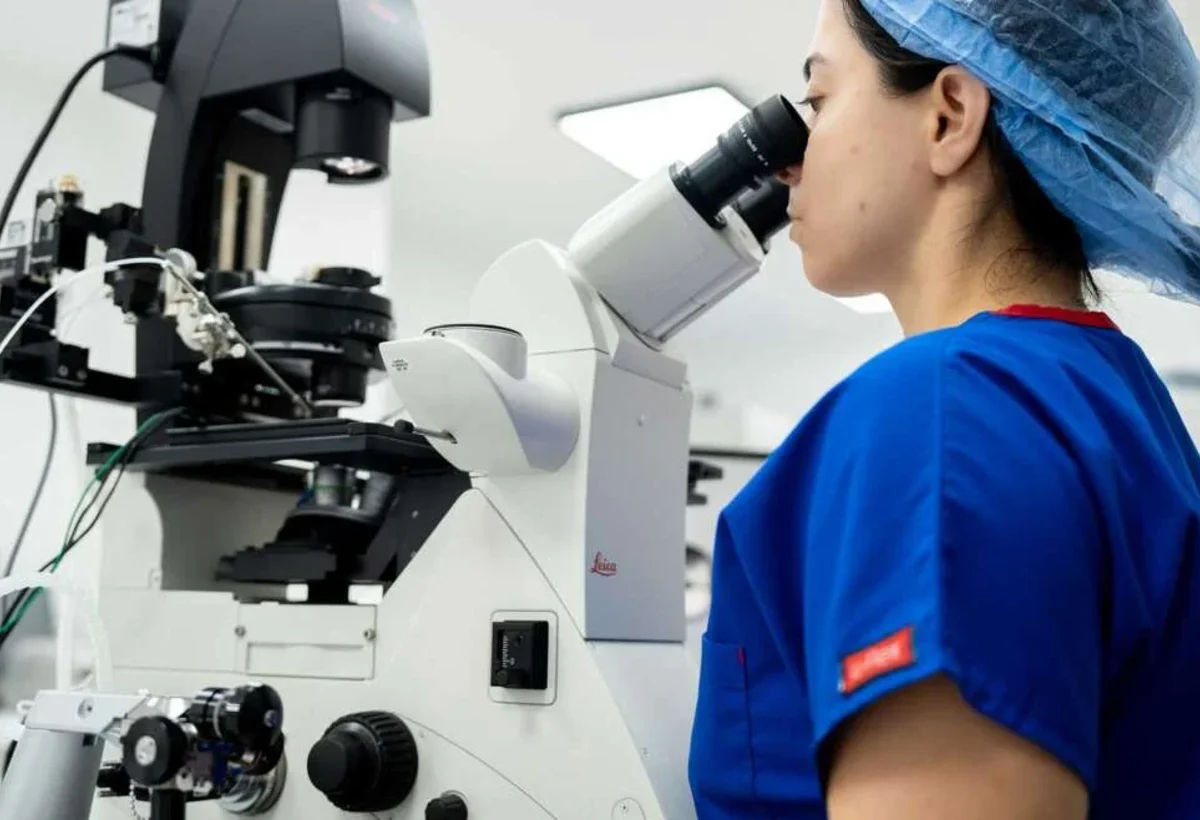 Clean air · Controlled culture environment
During your journey towards parenthood, we do not want invisible laboratory variables to be left to chance.
Embryo culture depends on more than incubator temperature. Air quality, gases, particles, pressure relationships and laboratory workflow all form part of the environment surrounding gametes and embryos.
Our aim is not to use the phrase “clean laboratory” as a marketing claim, but to manage environmental risks through engineering controls, maintenance, standard operating procedures and documented quality review.
Source prevention
Low-emission materials, controlled products and laboratory rules help reduce avoidable VOC sources.
Layered filtration
HEPA filtration addresses particles, while suitable chemical filtration is used for gas-phase contaminants.
Pressure and airflow
Airflow and pressure relationships are designed to reduce entry of uncontrolled air from adjacent areas.
Measurement and records
Environmental performance, maintenance and deviations are recorded as part of quality management.
What does a VOC-controlled embryology laboratory mean?
Volatile organic compounds are chemicals that can be released from construction materials, cleaning agents, fragrances, furnishings, traffic pollution and many everyday products. In an IVF laboratory, unnecessary exposure is reduced because gametes and embryos are handled outside the body.
A controlled laboratory approach combines appropriate HVAC design, particulate filtration, chemical adsorption, pressure management, low-emission materials, staff procedures and scheduled monitoring. Each layer addresses a different part of environmental control.
Important distinction: HEPA filters are primarily designed for particles. Gas-phase VOC control requires an appropriate chemical-filtration or adsorption strategy. A room being described as “clean” does not by itself demonstrate VOC control.
Even small environmental variables deserve structured control during embryo culture.
The effect of any single environmental factor cannot be separated from the whole laboratory system. For that reason, air management is treated as part of a wider quality programme rather than as a stand-alone device.
Source control
Reduce avoidable chemical and particulate sources before they enter the laboratory.
Air purification
Use appropriate filtration and ventilation strategies for particles and gas-phase contaminants.
Work discipline
Control doors, products, fragrances, cleaning procedures and movement within critical areas.
Monitoring
Review maintenance, measurements and deviations within the quality-management system.
How is laboratory air quality protected step by step?
A controlled environment is created through facility design, engineering controls and daily operational discipline. The exact monitoring programme depends on the laboratory design and validated procedures.
Facility and material selection
Construction, surfaces and furnishings are selected with contamination control in mind.
HVAC and pressure planning
Ventilation, air exchange and pressure relationships are designed for the laboratory workflow.
Particulate filtration
HEPA filtration is used where appropriate to reduce airborne particulate load.
Chemical filtration
Activated-carbon or other validated adsorption media may be used for gas-phase contaminants.
Operational protocols
Cleaning products, fragrances, door opening and staff movement are controlled by written procedures.
Measurement and maintenance
Filter changes, environmental checks and any deviations are documented and reviewed.
Which environmental variables are considered in an embryology laboratory?
Environmental quality is multidimensional. A single particle count or a single VOC reading does not describe the entire culture environment.
Monitoring frequency and acceptable limits should be defined within the laboratory’s validated quality programme and interpreted together with equipment and culture-system performance.
Volatile organic compounds
Gas-phase chemicals from indoor and outdoor sources may require dedicated control.
Particle load
Airborne particles are reduced using facility design, filtration and work practices.
Microbial load
Cleaning, workflow and environmental controls help limit avoidable microbial contamination.
Temperature and humidity
Room conditions are managed to support staff, equipment and stable laboratory operation.
Pressure and airflow
Pressure relationships help control the direction of air movement between areas.
Incubator gas quality
Incubator gases and culture conditions are monitored separately from room-air control.
General ventilation and IVF-specific environmental control
Laboratory air quality is a recognised quality consideration, but no single environmental metric can predict an individual IVF outcome.
Published laboratory guidance and studies discuss particulate, microbial and VOC control as components of good embryology-laboratory practice. The strength of evidence varies by contaminant, measurement method and clinical outcome.
The practical goal is therefore risk reduction and process consistency: identify avoidable sources, maintain engineering controls and investigate deviations rather than promise a direct improvement in pregnancy for every patient.
Environmental controls should be evaluated as part of the complete laboratory system, together with incubators, media, gases, equipment calibration, staff competency and clinical protocols.
Why do we state the limits clearly?
No absolute-zero claim. VOC concentrations can vary and measurement methods have practical limits.
One reading is not the whole system. Air quality should be interpreted together with airflow, particles, equipment and workflow.
No outcome guarantee. Environmental control cannot guarantee fertilisation, blastocyst formation, pregnancy or live birth.
Maintenance matters. A filtration system is only useful when correctly installed, maintained and monitored.
When is a controlled laboratory environment relevant?
Environmental quality is a laboratory-wide consideration rather than a procedure reserved for a particular diagnosis. Its importance is greatest wherever gametes and embryos are handled or cultured.
IVF and ICSI cycles
Gametes and embryos are exposed to laboratory conditions during handling and culture.
Extended blastocyst culture
Longer culture places greater emphasis on stable, well-managed laboratory systems.
PGT programmes
Biopsy, culture and cryopreservation add workflow stages that benefit from controlled processes.
Egg and embryo freezing
Cryopreservation work still depends on identity, equipment and environmental discipline.
Donation programmes
Multiple coordinated laboratory steps make traceability and environmental consistency important.
Quality assurance
Environmental records help laboratories review trends, maintenance and unexpected deviations.
What does this technology not do?
Clear limits help prevent unrealistic expectations and keep laboratory information in the correct clinical context.
It does not mean that laboratory air contains absolutely zero chemicals.
It does not guarantee more blastocysts, implantation, pregnancy or live birth.
It does not replace incubator quality control, culture-media management or embryologist expertise.
HEPA filtration alone should not be presented as complete VOC control.
Engineering systems require maintenance, monitoring and staff adherence to written procedures.
At Ventus IVF, air quality is managed as a system, not as a single device.
We consider facility design, filtration, pressure relationships, products used in critical areas, staff procedures and maintenance records together.
We avoid “zero-risk” language. The purpose of environmental control is to reduce avoidable variation and support a documented laboratory process.
Ask about your situationCommon questions about VOC-Controlled Embryology Laboratory
These answers provide general laboratory information and do not replace personalised medical advice.
Ask about your situationWhat are VOCs?
VOCs are volatile organic compounds that can be released from building materials, cleaning products, fragrances, traffic pollution and many other sources.
How can VOCs reach an IVF laboratory?
They may enter from outdoor air or be generated indoors. Facility materials, cleaning agents, cosmetics and nearby activities can all contribute.
Does a HEPA filter remove VOCs?
HEPA filtration is mainly used for particles. Gas-phase VOC reduction requires an appropriate chemical-filtration or adsorption approach.
Does “VOC-controlled” mean zero VOCs?
No. Absolute zero is not a realistic laboratory claim. The aim is source reduction, filtration, monitoring and controlled practice.
Can perfume and fragranced products matter?
Fragranced products can release volatile compounds, which is why many IVF laboratories restrict them in critical areas.
Does controlled air guarantee IVF success?
No. IVF outcomes depend on many patient, gamete, embryo, uterine and clinical factors. Environmental control is one part of laboratory quality.
Explore related technologies
Different laboratory technologies support different parts of assessment, safety, culture and cryopreservation.
Scientific sources and further reading
- Cairo consensus on IVF laboratory air quality and environmental control. Source ↗
- Published review on laboratory air quality and assisted reproduction. Source ↗
- Study addressing VOCs and air quality in the IVF laboratory. Source ↗
- ASRM guidance for human embryology and andrology laboratory management and operations. Source ↗
Ask how laboratory environmental control fits into the wider IVF quality system.
Our team can explain how culture conditions, air management, equipment monitoring and embryology procedures are brought together during treatment.