
Vitrification Technology
Vitrification is a rapid cryopreservation method used for suitable oocytes and embryos. By combining controlled exposure to cryoprotective solutions with very rapid cooling, the technique aims to minimise ice-crystal formation during freezing.
- Rapid coolingVery high cooling rates are used with small solution volumes.
- Controlled timingCryoprotectant exposure and handling times follow a validated protocol.
- Warming mattersSuccessful cryopreservation depends on the warming process as well as freezing.
Vitrification is an established cryopreservation technique, but survival after warming and later treatment outcomes cannot be guaranteed for every oocyte or embryo.
 Vitrification · Rapid cryopreservation
The aim is to preserve suitable oocytes and embryos through a carefully controlled freezing, storage and warming process.
Cryopreservation may be used for fertility preservation, surplus embryos, freeze-all strategies or treatment plans that require transfer at a later time.
The result depends on more than cooling speed. Oocyte or embryo quality, solution exposure, device handling, storage conditions and warming technique all form one continuous laboratory process.
Rapid temperature change
Vitrification uses rapid cooling to reduce the opportunity for damaging ice crystals to form.
Validated solution exposure
Cryoprotective solutions are used in defined concentrations and exposure times.
Small-volume handling
Specialised devices and minimal solution volumes support rapid heat exchange.
Controlled warming
Rapid and correctly timed warming is essential to the complete vitrification protocol.
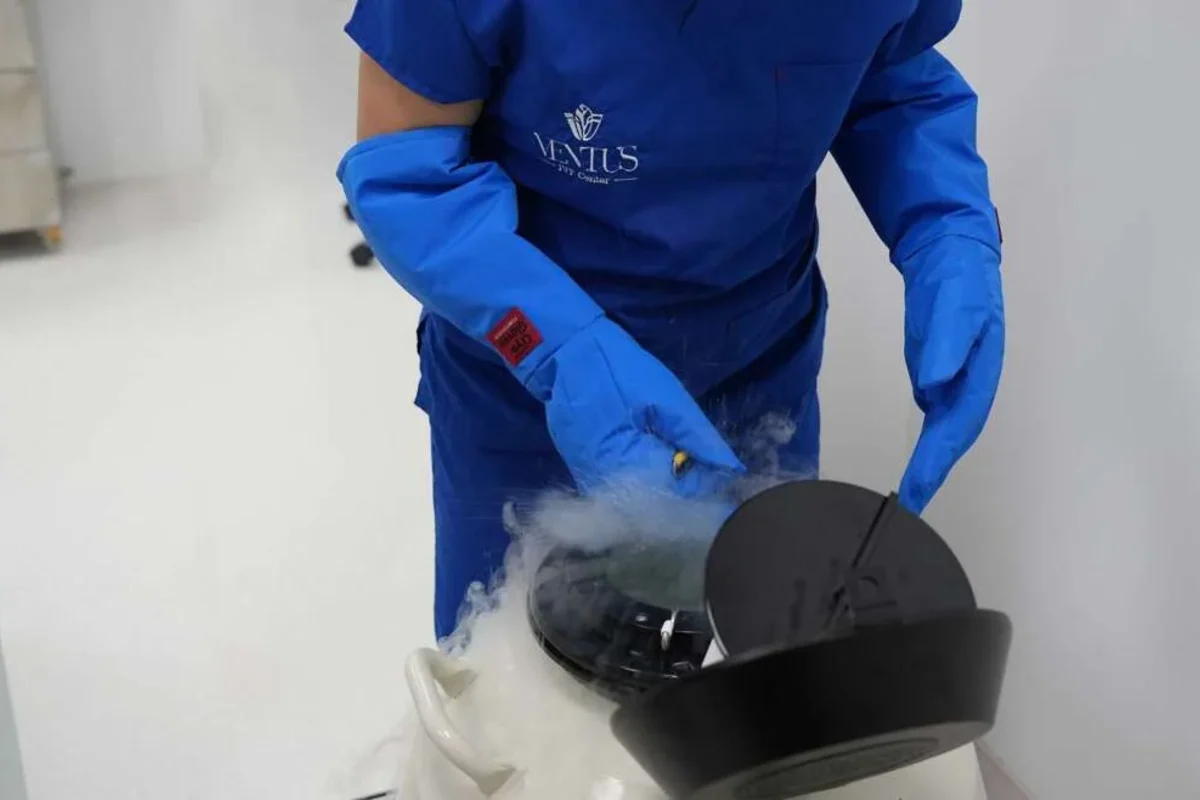
What is vitrification?
Vitrification is a cryopreservation method in which oocytes or embryos are exposed to cryoprotective solutions and cooled extremely rapidly. The objective is to move the solution into a glass-like state rather than allowing large ice crystals to develop.
It is used in modern IVF laboratories for cryopreservation of appropriate oocytes and embryos. The exact protocol, device and timing depend on the developmental stage and the laboratory’s validated procedures.
Important distinction: vitrification does not make biological material “unchanged forever”. Cryopreservation reduces metabolic activity at cryogenic temperatures, but survival after warming and subsequent developmental potential remain biological outcomes.
Assessment, vitrification, storage, identification and warming must work together.
A technically successful freezing step is not enough on its own. Traceability, stable cryostorage, inventory control and a validated warming process are equally important parts of safe cryopreservation.
Assessment
Suitable oocytes or embryos are identified for cryopreservation.
Vitrification
Controlled cryoprotectant exposure and rapid cooling are performed.
Storage
Cryodevices are identified and placed in monitored cryogenic storage.
Warming
Material is warmed using the validated protocol before later use.
How is vitrification performed step by step?
Protocols vary by developmental stage and laboratory system. The sequence below describes the general laboratory logic rather than a patient-specific protocol.
Suitability is reviewed
The developmental stage and morphology of the oocyte or embryo are documented.
Initial solution exposure
Cells are gradually exposed to cryoprotective conditions according to the validated protocol.
Final solution and loading
The sample is transferred through the vitrification solution and loaded using controlled timing.
Rapid cooling is performed
The cryodevice is cooled rapidly to achieve vitrification.
Identity and location are recorded
The cryodevice is stored in the designated cryogenic location with traceability controls.
Rapid warming and dilution
When clinically planned, the sample is warmed and cryoprotectants are removed in a controlled sequence.
Which variables matter during vitrification and warming?
Cryopreservation outcomes depend on both biological and technical variables. The laboratory therefore controls timing, temperature, solution handling and identity at every stage.
A survival percentage from another clinic or another patient should not be treated as an individual guarantee.
Developmental stage
Oocytes, cleavage-stage embryos and blastocysts require stage-appropriate handling.
Morphology before freezing
Pre-vitrification quality is documented because it influences later interpretation.
Exposure time
Cryoprotective solutions must be used within validated timing windows.
Temperature control
Solution and handling temperatures affect osmotic and thermal conditions.
Cryodevice and volume
Loading method and solution volume influence heat transfer.
Warming response
Post-warming survival and re-expansion are assessed before further clinical planning.
Slow freezing and vitrification
Vitrification is widely used for oocyte and embryo cryopreservation, while survival and reproductive outcomes still vary by material, stage and laboratory practice.
Professional guidance describes rapid-cooling vitrification as a core cryopreservation approach in modern assisted reproduction. Technique, device handling, storage governance and warming protocols all contribute to performance.
Outcome statistics should be interpreted by developmental stage and laboratory context. A high average warming-survival rate does not guarantee survival or pregnancy for an individual oocyte or embryo.
Vitrification is best understood as a controlled preservation method. It preserves the possibility of later use; it cannot guarantee that every cell survives warming or produces a pregnancy.
Why do we state the limits clearly?
Survival is not guaranteed. Some oocytes or embryos may not survive warming.
Biology still matters. Age, oocyte quality and embryo quality remain important.
Storage systems matter. Identification, tank management and emergency planning are part of cryopreservation safety.
Warming is critical. A validated warming process is as important as the vitrification step.
When may vitrification be used?
The clinical reason for cryopreservation varies. The decision should be based on the treatment plan, biological material available and informed consent.
Embryo cryopreservation
Suitable embryos not transferred in the current cycle may be preserved for later use.
Egg freezing
Mature oocytes may be vitrified for fertility preservation or planned future treatment.
Freeze-all cycles
All suitable embryos may be cryopreserved when transfer is intentionally deferred.
PGT cycles
Embryos are commonly vitrified after biopsy while genetic results are pending.
Donation programmes
Cryopreservation may be part of donor-oocyte or embryo logistics where clinically and legally appropriate.
Treatment scheduling
Preservation can separate laboratory creation of embryos from the timing of a later transfer.
What does this technology not do?
Clear limits help prevent unrealistic expectations and keep laboratory information in the correct clinical context.
It does not guarantee that every oocyte or embryo will survive warming.
It does not guarantee implantation, pregnancy or live birth after future use.
It does not reverse age-related biological factors present before freezing.
It does not replace identity, inventory and cryostorage safety systems.
Storage duration, consent and future-use rules must follow applicable clinical and legal requirements.
At Ventus IVF, vitrification is managed together with identity, storage and warming.
We document the material being frozen, the cryodevice, storage location and later warming process as one traceable laboratory pathway.
We explain cryopreservation as an opportunity for future use, not as a promise that every frozen oocyte or embryo will lead to treatment success.
Ask about your situationCommon questions about Vitrification Technology
These answers provide general laboratory information and do not replace personalised medical advice.
Ask about your situationWhat is the difference between freezing and vitrification?
Vitrification is a rapid cryopreservation technique designed to minimise ice-crystal formation by combining cryoprotectants with very rapid cooling.
Can both eggs and embryos be vitrified?
Yes, mature oocytes and embryos at appropriate developmental stages can be vitrified using validated stage-specific protocols.
Does every vitrified embryo survive warming?
No. Survival rates can be high in experienced laboratories, but no individual embryo can be guaranteed to survive.
Can vitrification damage an embryo?
Cryopreservation creates osmotic and thermal stress. Validated protocols are designed to limit this risk, but biological response varies.
How long can embryos remain frozen?
Cryogenic storage can preserve material for long periods, but permitted storage duration and consent requirements depend on applicable rules and the individual storage agreement.
Is warming as important as freezing?
Yes. Rapid, correctly timed warming and cryoprotectant dilution are essential parts of the vitrification process.
Explore related technologies
Different laboratory technologies support different parts of assessment, safety, culture and cryopreservation.
Scientific sources and further reading
- ASRM review of best practices for rapid-cooling vitrification of oocytes and embryos. Source ↗
- ASRM committee opinion on cryostorage of reproductive tissues in the IVF laboratory. Source ↗
- Recent publication on outcomes and practice in embryo/oocyte vitrification. Source ↗
- ASRM guidance for human embryology and andrology laboratory management and operations. Source ↗
Ask how vitrification, storage and warming may fit into your treatment plan.
Our team can explain which oocytes or embryos may be suitable for cryopreservation, how material is stored and what to expect when future warming is planned.