
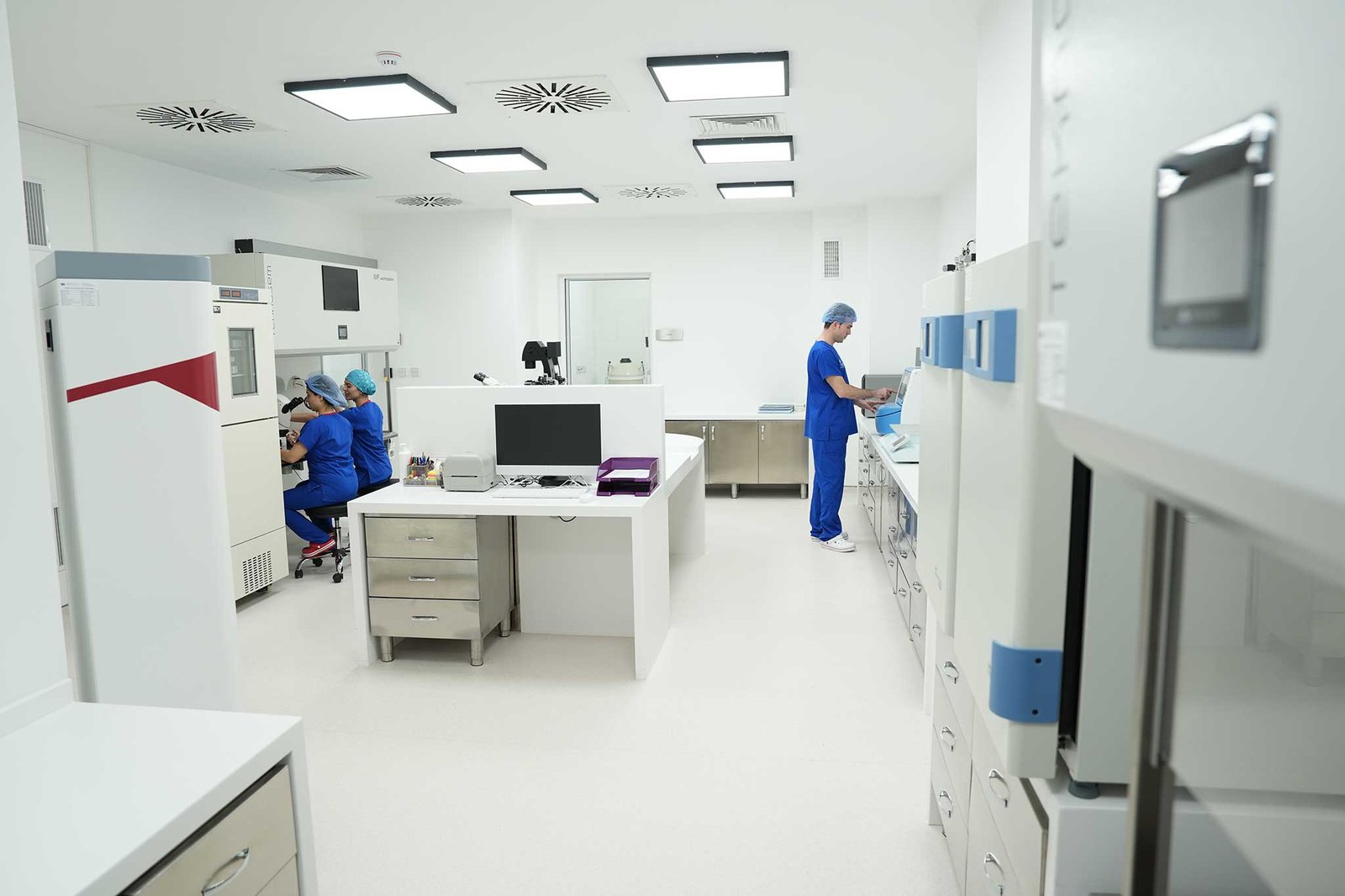
The quality of air within an IVF lab will inevitably affect embryonic development and therefore has a critical impact on IVF success. Some pollutants called VOCs (Volatile Organic compounds) can be found in construction materials, PVC flooring, oil based paints and adhesives, cleaning fluids, floor waxes, cosmetics and cigarette smoke.
VOCs as the name suggests are emitted as gases from certain solids or liquids. Building materials and furnishings, such as new carpets or furniture, slowly release VOCs over time. When you use a product containing VOCs indoors, the levels of these chemicals in the air increase then decrease over time after you stop using them.
It is easy to see that these chemicals can easily find their way into the laboratory and how the quality of the air can have a profound effect on the developing embryo. In an operating room, we concern ourselves with bacteria which are very small, however, in an IVF laboratory, we are concerned with smells and air pollutants that are represented by molecules many thousand times tinier than even a bacterium. Embryos do not breathe like we do, but they have no protection and are in direct contact with the air.
The pre-implantation embryo development is dynamic and is responsive to external signals, they sense and adapt to their environment either (in vivo) inside the body, dependent upon maternal nutrition and lifestyle or in vitro cultures in the IVF laboratory.
Volatile organic compounds (VOCs) are harmful to embryos during embryonic growth and development. They can directly attach to DNA and abort growth and have also been associated with increased DNA fragmentation in human sperm.
Since embryo development and implantation depends so highly on its culture environment, Ventus IVF spares no effort to ensure that the quality of air is of optimum quality. The IVF laboratory applies stringent regulatory standards in matters of particle control and especially molecular air quality.
Air quality and continuous maintenance of laboratory equipment is also an essential aspect of our lab program. Highly filtered air being flushed through High Efficiency Particulate Air (HEPA) filters under positive pressure, which leads to a cleaner environment overall. “Clean room technology” creates a carefully controlled sealed environment in which the entry of particles and contaminants is significantly minimized.
We’ve installed a special air filtration system designed for IVF laboratories that removes particulate and VOC contamination.
Positive pressure is maintained throughout the laboratory so that outside contamination cannot enter the lab environment. Solvent free adhesives have been used for floor covering which have low VOC emissions as well as “ecological” water based paints that contain non-volatile chemicals . Regular Epoxy paints emit VOCs and can contain alkanes, aromatics, alcohols, aldehydes and ketones amongst others that take several weeks to cure. The laboratory has smooth, non-porous water based painted walls and lighting is sealed in order to help reduce airborne particles.
Air quality and continuous maintenance of laboratory equipment is also an essential aspect of our lab program. Petri dishes for oocyte and embryo cultures are prepared a day in advance of the procedure so that sufficient time is allotted for the culture to reach the desired temperature and pH equilibration. Unauthorized personnel, packaging and other materials into the laboratory are restricted and general good hygiene is practiced. Clean room clothing provides maximum control against microbial and particle contamination. These polyester garments act as particle barriers which shed no fibers into the environment. Also, products like cosmetics emit VOCs, especially perfumes, colognes, and deodorants. They are highly toxic to embryo development in vitro, primarily due to evaporation of their solvent bases. Validation of air quality is measured periodically and we also calculate key performance indicators such as in vitro fertilization rate, cleavage rates, embryo quality and pregnancy rates continuously to ensure that the laboratory is running as expected.